





Elite Restaurant Equipment / Restaurant Equipment / Stainless Steel Work Tables / Commercial Work Tables: A Restaurant Buyer's Guide
Commercial Work Tables: A Restaurant Buyer's Guide
By ERE Editorial Team. Last updated: April 2026.
The work table is the most-used surface in any commercial kitchen. It is where prep happens, where mise en place lives, where every cook station begins and ends the day. A poorly-chosen table fails in two ways: it loses square inches you needed (under-sized), or it eats square footage you couldn't spare (over-sized). A well-chosen one disappears into the workflow — which is exactly the goal.
The decision is not complicated, but it has more dimensions than most buying guides admit. Material, gauge, height, depth, undershelf type, backsplash, casters, and how the table fits the stations on either side. This guide covers the actual decision framework, not a parts list.
Elite Restaurant Equipment ships work tables to commercial kitchens nationwide from our Newark, NJ warehouse. We carry the full Universal work table line — 392 SKUs spanning the popular SG-series stainless steel work tables in every common commercial size — alongside John Boos butcher blocks for dedicated cutting stations. The decision below is brand-agnostic. The catalog backs whichever direction is right for your kitchen.
Types of commercial work tables
Most commercial kitchens need more than one type of work table. The right configuration depends on what the station does, where it sits in the kitchen, and how it has to perform during service. Here are the six configurations ERE stocks across the Universal and John Boos catalogs.
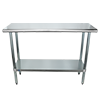
1. Stainless Steel Work Tables
- Best for: general prep, plating, assembly, garnish — the workhorse surface of every commercial kitchen
- Build: 16 gauge stainless steel top, ASTM A240 grade 304 standard, NSF/ANSI Standard 2:2022 certified by major manufacturers
- Sizes: 24" to 96" wide, 24" to 36" deep, 34" to 36" working height
- Catalog depth: Universal SG-series, 392 SKUs across nearly every common configuration
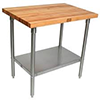
- Best for: dedicated cutting stations — protein breakdown, cheese, vegetables, bread service
- Build: hard rock maple, 1-3/4 inch minimum thickness for commercial use, galvanized or stainless under-base
- Sizes: 24" to 60" wide typical, 24" to 36" deep
- Catalog depth: John Boos JNS-series and HNS-series, 140+ SKUs
- Best for: holding heavy countertop cooking equipment (charbroiler, griddle, fryer, mixer) at working height with structural reinforcement
- Build: 16 gauge stainless top with reinforced sub-frame for sustained static load
- Sizes: 24" to 48" wide, 12" to 36" deep
- Catalog depth: Universal ES-S series, sized to match cooking equipment dimensions
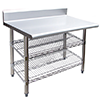
4. Work Tables with Backsplash
- Best for: stations placed against a wall — prevents food and liquid from sliding into the wall gap (sanitation + pest control)
- Build: standard 1.5-inch rear backsplash, all other specs match base stainless steel work table
- Sizes: matches the base work table line (24" to 96" wide)
- Note: island stations not against a wall should use the flat-top variant instead
5. Work Tables with Wire Undershelves
- Best for: prep stations needing both prep surface and visible storage — washed produce, drying utensils, stations where airflow matters
- Build: stainless top + wire shelf below, optional rear backsplash
- Sizes: matches base work table line
- Why: the undershelf doubles the usable storage of the table footprint without adding floor space
6. Mobile work tables (caster-equipped)
- Best for: kitchens that need to reconfigure stations for catering, deep cleaning, or remodels
- Build: any base work table with 5-inch casters — typically two locking and two non-locking, or all four locking for production use
- Sizes: any standard work table size
- Note: casters retrofit onto most existing tables; check the leg base type before ordering
Each section below dives deeper into the decision math behind these configurations — how to choose between materials, how to size correctly, what build details actually matter at inspection time, and the buying mistakes that cost the most.
How to choose: stainless steel vs. butcher block
The first decision is the surface. There are exactly two materials worth considering for a commercial kitchen — stainless steel and butcher block — and the choice hinges entirely on what the table will do.
Stainless steel is the right answer for nearly every general-purpose work table. It is smooth, non-absorbent, sanitizable, and complies with the FDA Food Code 2022 requirement that food-contact surfaces be cleanable and free of cracks or seams that harbor pathogens. Major manufacturers build to NSF/ANSI Standard 2:2022 for food equipment, which is what your local health department wants to see during inspection.
Look for 16 gauge stainless steel on the top, and ASTM A240 grade 304 stainless if you can find it. Cheaper tables use grade 430, which is magnetic and slightly more prone to corrosion in salt-heavy environments. The number "16 gauge" is counterintuitive: it is actually thicker than 18 gauge, because lower gauge numbers mean thicker steel. Thinner gauges flex under load, dent under impact, and develop a slightly bowed top after a few months of heavy prep. The Universal commercial line uses 16 gauge as standard, which is the floor for any serious commercial use.
Butcher block is the right answer when the table is a dedicated cutting station — not a prep table that occasionally cuts, but a station where the primary work is breaking down protein, cheese, vegetables, or bread. Wood is gentler on knife edges than steel, absorbs the impact of repeated chops, and (when properly maintained) is bacteriostatic: hard maple has natural antimicrobial properties that have been documented in food-safety research dating back to the early 1990s.
The standard maple butcher block thickness for commercial use is 1-3/4 to 2-1/4 inches. Anything thinner is a residential product. Anything thicker is for specialty cutting like oversized protein breakdown or quartered carcass work. The John Boos butcher block line ERE carries — including the JNS01 (36" x 24"), JNS08 (36" x 30"), and JNS15 (36" x 36") — uses hard rock maple at 1-3/4 inch minimum, which is the industry baseline for commercial cutting. John Boos has been making butcher blocks since 1887, and that build quality is the reason their products carry a price premium. For a kitchen that cuts protein every day, that premium pays back in surface longevity. For a kitchen that uses a butcher block twice a week, a stainless top with a polyethylene cutting board insert is usually the better economic decision.
The decision rule: if cutting is the primary function of the station, butcher block. If cutting is one of several things the station does, stainless steel plus a properly-sized cutting board gives you flexibility plus a fraction of the cost. Most kitchens need 2 to 4 stainless work tables and one dedicated butcher block station — not five butcher blocks.
Sizing your work table: depth, height, footprint
This is where most kitchens get it wrong, and the mistake is almost always the same: under-sizing the depth. A 24" deep table looks fine in a showroom and disappears in real prep work because once you have placed a cutting board, a half-pan of mise en place, a sheet pan, and a quart container of seasoning, you have used every inch.
Depth is the most consequential decision. Standard commercial work tables come in 24", 30", and 36" depths. ERE carries Universal work tables across all three. The right answer depends on your wall constraints and prep style:
- 24" depth is for tight spaces, against a wall, and stations that don't hold large pans or sheet trays. It is the floor — anything narrower isn't a commercial work table.
- 30" depth is the workhorse. It accommodates a full sheet pan (18" x 26") with prep space in front, holds a deli case worth of mise en place, and is the right answer for roughly 70% of kitchens.
- 36" depth is for island stations and high-volume prep where the cook works on both sides. Worth the extra footprint when you have it.
Width ranges from 24" to 96" in single-piece commercial units, with the Universal line offering nearly every increment. The right width is whatever fills the wall or station footprint with no wasted gap. Two 48" tables are usually more flexible than one 96" table because they can be relocated independently as the kitchen evolves — but a single 96" run is more sanitary (one less seam) and slightly cheaper per linear foot.
Height is standardized at 34" to 36" for all commercial work tables. This isn't arbitrary: it matches OSHA-recommended ergonomic standing-work height for the median adult worker. Lower than 34" causes back strain on standing prep. Higher than 36" makes downward knife pressure awkward. If your team includes workers significantly outside the median height range, a fatigue mat at the station is the standard accommodation, not a custom table height.
Popular Universal SG-series sizes: The SG line is the volume seller in the Universal commercial work table catalog — stainless steel top, 16 gauge, galvanized undershelf. The four most-shipped configurations:
| Model | Size (W × D) | Best for |
|---|---|---|
| Universal SG2424 | 24" × 24" | Tight wall stations, secondary prep, garnish |
| Universal SG3030 | 30" × 30" | Standard prep workhorse for roughly 70% of kitchens |
| Universal SG3036 | 30" × 36" | Wider prep, sheet pan workflow, cookline staging |
| Universal SG3048 | 48" × 30" | High-volume prep, two-cook stations, island layouts |
Click any model above for current pricing, stock, and full specs — product pages are the source of truth.
All four ship at the standard 36" working height and use 16 gauge stainless steel on the top, with a galvanized undershelf for under-table storage. For wall-mounted stations, add the backsplash configuration; for island stations, the flat-top variant is the right choice.
Footprint math: for new restaurant builds, a useful rule of thumb is 1 linear foot of prep table per 10 covers at peak service. A 100-cover restaurant typically needs about 10 feet of prep table — a single 8-foot stainless run for the main prep station plus a 36" x 30" butcher block for protein breakdown. Add 6 inches of clearance on every side so the cook can work without colliding with the next station.
Equipment stands: when a work table isn't the right answer
Equipment stands are not work tables. They look similar — same height, same materials, often the same brand — but they are built for a completely different job: holding a heavy piece of countertop equipment (charbroiler, griddle, fryer, mixer, coffee machine) at working height with the structural reinforcement to support sustained weight and heat.
The Universal equipment stand line is built with the same 16 gauge stainless steel top as the work table line, but with a reinforced sub-frame, thicker leg gauge, and (on most models) a built-in undershelf for cookware storage directly below the equipment. Stands ship at the standard 36" working height in widths from 24" to 48", sized to match the cooking equipment they support. Browse the equipment stand catalog for the configuration that fits your line.
The rule: if you are putting countertop cooking equipment on a surface, use an equipment stand, not a work table. A work table top will dent and warp under sustained heat and weight. The visual difference is small. The structural difference is everything.
Wire undershelves and the workspace gain most kitchens miss
Adding an undershelf to a work table effectively doubles the usable storage of the table footprint — the original tabletop plus the undershelf storage in space the table footprint already occupied. For kitchens fighting for every square inch, this is one of the highest-ROI upgrades on a work table purchase.
The choice between wire and solid undershelves is straightforward:
- Wire undershelves are better for storing items that need to drain (washed produce, drying utensils), for visibility (you can spot what is on the shelf at a glance), and for airflow (preventing moisture buildup). They are slightly harder to clean spilled liquids from but easier to inspect.
- Solid (galvanized or stainless) undershelves are better for storing dry goods, holding small appliances or bus tubs, and for stations where the undershelf occasionally takes a load directly. They are easier to wipe down between services.
For most prep stations, wire wins. For cookline stations and dish areas, solid wins. Universal carries both configurations across the entire work table size range. SKU prefixes indicate the configuration: USS series for stainless steel undershelves (such as USS1424 for a 14" x 24" table), UGS series for galvanized undershelves (such as UGS1424). Wire variants are denoted in the SKU description.
Galvanized undershelves cost less than stainless — usually 15 to 25 percent less per equivalent size. The trade-off is durability in damp environments. For a dry storage station, galvanized is fine. For a wet-prep station near a sink or dish area, stainless pays back over the equipment lifecycle.
Casters, backsplashes, and inspection-ready build
Three small build decisions matter more than they look.
Backsplash. A 1.5-inch stainless backsplash on the rear edge of the table prevents prep ingredients from sliding off the back into the wall gap, where they become a sanitation problem and an inspection finding. Universal makes most work tables available with or without a backsplash. The upcharge is small and the pest-control benefit is real. The exception is island stations not against a wall — those stay flat.
Casters. Adding casters to a work table makes the difference between a fixed station and a kitchen that can be reconfigured for catering, deep cleaning, or remodeling. Look for 5-inch wheels (smaller wheels catch on floor seams), with two locking and two non-locking. For tables that hold heavy mise en place or production work, all four locking is the safer choice. Casters typically sell in packs of four. Common manufacturers include Winco, Thunder Group, and Universal.
Cross-bracing vs undershelf. Lower-cost work tables use a single horizontal cross-brace between the legs instead of an undershelf. The cross-brace adds rigidity without adding storage. It is the right answer when the station genuinely doesn't need under-table storage — for example, a dedicated cutting station where the floor space below the table needs to stay clear for daily cleaning. For most stations, an undershelf is the better use of the space.
Five buying mistakes to avoid
- Sizing for the empty table, not the working table. A 24" deep table looks spacious empty. Add a half-pan and a cutting board and you have eight inches of prep room left. Always size for the actual working configuration, not the showroom configuration.
- Buying butcher block for general prep. Maple is a premium surface for cutting. For everything else — assembly, plating, garnish, dry storage staging — it is a worse surface than stainless because it requires regular oiling and is more vulnerable to liquid damage. Stainless plus a polyethylene cutting board on top covers 90 percent of use cases for less money.
- Skipping the undershelf to save $50. The undershelf is one of the highest-ROI additions in any commercial kitchen build — it doubles the usable storage of the table footprint. The savings on a no-shelf SKU disappear in three days of trying to find somewhere to put bus tubs.
- Underestimating gauge. 18 gauge stainless tops dent, bow, and develop a slight crown after months of heavy use. 16 gauge holds flat for years. The price difference is usually under $40 per table. Pay it.
- Forgetting Section 179. Commercial work tables, equipment stands, and most kitchen equipment are eligible for the IRS Section 179 deduction — the full purchase price is deductible in the year the equipment is placed in service, up to the annual limit. For a kitchen building out 10 work tables, that is a meaningful tax advantage. ERE offers in-house financing on equipment purchases — see the financing page for current terms and how Section 179 can stack with installment financing.
Frequently asked questions
What size work table do I need for a small restaurant kitchen?
For a kitchen serving up to 50 covers per service, a single 30" x 60" or 30" x 72" stainless steel work table is usually enough for the main prep station, plus a smaller (24" x 36" or 24" x 48") secondary table for plating or garnish. Most small kitchens add a 36" x 24" butcher block as a dedicated cutting station only when protein breakdown is part of the daily workflow.
Is stainless steel or butcher block better for food prep?
Stainless steel is better for general prep — it is faster to sanitize, doesn't require maintenance, and works for every food category. Butcher block is better only for dedicated cutting stations where wood's knife-friendly surface and bacteriostatic properties are real advantages. Most kitchens need more stainless than butcher block, not the other way around.
What gauge of stainless steel should I look for in a commercial work table?
16 gauge is the commercial floor. 18 gauge bends and bows under sustained load. 14 gauge exists for heavy-duty applications, but the ROI versus 16 gauge is small for normal prep work. Universal commercial work tables use 16 gauge as standard.
Are commercial work tables NSF certified by default?
Most major manufacturers (Universal, John Boos, Eagle, Advance Tabco) build to NSF/ANSI Standard 2:2022 for food equipment. Local health departments expect to see NSF certification on the table label during inspection. If you are buying from a discount source, verify the NSF mark on the spec sheet before purchase — non-certified tables can fail inspection and require replacement at your cost.
How thick should a butcher block be for daily commercial use?
1-3/4 inches is the commercial baseline for hard rock maple. 2-1/4 inches is the standard for high-volume cutting stations. Anything under 1-3/4 inches is a residential or light-commercial product and will dish out (develop a concave depression) within months under daily use.
Do commercial work tables need a backsplash?
Tables placed against a wall should have a 1.5-inch rear backsplash to prevent food and liquid from falling into the wall gap, which causes sanitation and pest issues. Island tables not against a wall don't need one. The upcharge is small enough that "always order with backsplash unless it is an island station" is a reasonable default.
Can I add casters to any work table?
Most commercial work tables accept aftermarket casters, but check the leg base. Tables with welded cross-bracing at the floor are easier to retrofit; tables with simple post legs may need an adapter plate. Universal sells caster kits compatible with their work table line — look for the matching SKU prefix when ordering.
The right work table pays for itself
A commercial work table is not a commodity purchase. It is a station that determines how every cook on your line spends their day. Sized right, gauged right, configured right, and matched to its actual job, it disappears into the workflow — which is the only metric that matters. Sized wrong or under-built, it is friction added to every shift for years.
Browse ERE's full stainless steel work tables, butcher block work tables, and equipment stand catalog. For build-out financing and Section 179 questions, see the ERE financing page. For specific configuration help, sizing math, or NSF compliance for your local jurisdiction, call our team in Newark, NJ.
By ERE Editorial Team. ERE is part of the commercial restaurant equipment buying guides hub. See verified customer reviews for buyer feedback on the brands above.